This blog is part of a series from the US Water Alliance’s Environmental Finance Center (EFC) team highlighting technical assistance projects and successes in communities across the country through RealWaterTA. This free, federally funded program helps communities improve their drinking water, wastewater, and stormwater infrastructure; achieve regulatory compliance; and secure federal funding.
Community: Cambridge, Maryland
Technical assistance offered: Support for a drinking water, wastewater, and stormwater rate/fee study.
Background
The Alliance began working with Cambridge, Maryland, in March 2026. The community identified several infrastructure needs related to its sewer collection system, which is vulnerable to inflow and infiltration during rain events and tidal flooding from the Choptank River. The community also identified a need to secure funding sources to support future infrastructure improvements.
After learning more about these challenges, The Alliance worked with the community to determine the best path forward. Together, they agreed to bring on a consultant to conduct a study and develop a rate structure that would account for the community’s future, potentially costly infrastructure repair and improvement needs.
Plan of Action
In July 2026, following a competitive bidding process, staff from the community, the Alliance, and the consultant came together to kick off the rate study project. The community is taking a data-driven approach to designing future utility rates—one that balances affordability with long-term utility sustainability. The goal is to ensure the utility has the resources needed to make critical infrastructure investments while continuing to provide high-quality service to the community. The community is also exploring a dedicated funding source to support stormwater infrastructure specifically.
Community: Eagle Harbor, Maryland
Technical assistance offered: Support with coordinating existing technical assistance resources and planning infrastructure investments for water and wastewater services.
Background
The Alliance began working with Eagle Harbor, Maryland in May 2025, following an introduction by its partner, Engineers Without Borders. At that time, Engineers Without Borders was preparing a Drinking Water Preliminary Engineering Report (PER), while a Wastewater PER was being developed through the Environmental Protection Agency’s Closing America’s Wastewater Access Gap (CAWAG) program. Several other organizations were also working in Eagle Harbor on water quality sampling and the installation of household filtration systems, including the Southeast Rural Community Assistance Project (SERCAP), Ridge to Reefs, and Green Mechanics.
The Alliance’s initial role focused on coordinating the different teams working in Eagle Harbor and helping the community understand how various projects were connected. This included several initial steps:
- Meeting with the Mayor and Board of Commissioners
- Meeting with community members
- Meeting with different technical assistance teams and other organizations
- Reviewing existing data and documentation.
The Alliance then worked with the community and technical assistance providers to create a community work plan to address data gaps, leverage the PERs being developed, and ensure that other community needs and priorities were being considered.
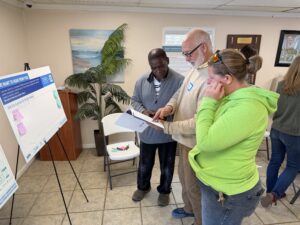
Public officials, engineers, and community members share data and information at a community meeting
Plan of Action
In October 2026, the Alliance held an event at the Eagle Harbor community center to share information about the drinking water and wastewater PERs. Representatives from Green Mechanics, Engineers Without Borders, SERCAP, and Ridge to Reefs were also present to answer questions about their ongoing work in Eagle Harbor.
The teams presented a plan of action outlining next steps, including comprehensive GPS mapping of the community’s existing infrastructure, beginning in Fall 2026 by Engineers Without Borders with support from community volunteers. The resulting map will be used to overlay current water quality data and potential water and wastewater solutions identified in the PERs.
Once the community has identified feasible infrastructure options to address its water and wastewater needs, the Alliance will support Eagle Harbor with rate studies, cost estimates, and funding applications. This assistance will help Eagle Harbor move toward implementing a solution that builds upon the work underway over the past several years.
Eagle Harbor’s challenges are not unique, and the work underway offers valuable lessons that could benefit other communities facing similar infrastructure needs. With this in mind, the Alliance is working with the community to create video case study highlighting the project and sharing lessons learning from ongoing infrastructure planning efforts in Eagle Harbor.
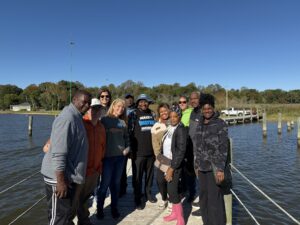
Elected officials, community members, and technical assistance providers on the pier at Trueman Point
Community: Beaufort County, North Carolina
Technical Assistance offered: Support the development of a pilot program to repair or replace failing septic systems.
Background
The Alliance began working with Beaufort County, North Carolina, and partners at the Mid-East Commission—the local Council of Governments—in early 2026. Beaufort County applied for the newly launched Clean Water State Revolving Fund (CWSRF) Decentralized Wastewater Treatment Systems Pilot Program. This program allows eligible applicants to establish a grant and/or loan program for decentralized wastewater repairs and replacements within their jurisdiction. Beaufort County was awarded $500,000 of principal forgiveness to establish the program and distribute funds to homeowners who meet income eligibility criteria. Beaufort County is working with the Mid-East Commission to administer the program.
Plan of Action
As a pilot program, Beaufort County is responsible for establishing programmatic goals, eligibility requirements, funding caps, a prequalification process for contractors to perform repairs and/or replacements, project selection criteria and rubrics, and a process for evaluating the program – all without a pre-existing model to replicate. The US Water Alliance’s EFC team has stepped in to advise Beaufort County and the Mid-East Commission on program development, implementation, and evaluation.
To date, this has included recurring meetings and strategy sessions, as well as the creation of a series of process diagrams that lay out program implementation, the flow of funds (e.g., how money moves from the CWSRF to the County to contractors), and the prequalification process for septic contractors. Additionally, the Alliance has helped Beaufort County develop a “Mini-Intended Use Plan” modeled after the CWSRF Intended Use Plan, providing a clear overview of the funding program—including application and award processes—for interested applicants. Finally, the Alliance has developed outreach materials to help promote the program, which will be shared by Beaufort County.
The program is slated to launch in late 2026. The Alliance anticipates continuing to work alongside Beaufort County and Mid-East Commission to refine the process diagrams and Mini-Intended Use Plan, provide advising as needed during the prequalification phase and as the program launch, and assist with program evaluation as funds are expended.
This pilot program represents an important opportunity to address failing septic systems, which can contribute to nutrient loading, drinking water contamination, and other environmental and public health concerns. By helping Beaufort County establish a framework for septic system repairs and replacements, the Alliance is supporting a program that could serve as a model for other communities facing similar challenges.
East Coast Summary
While each community faces unique water infrastructure challenges, these projects highlight the importance of tailored technical assistance in helping communities plan long-term solutions. Through collaboration, strategic planning, and financial guidance, the Alliance is helping communities across the East Coast build the capacity and resources needed to make critical infrastructure investments and strengthen their water systems for the future.
Continue this blog series with case studies from Washington, California, and the Midwest.