By Korrin Davis, Program Manager, Water Equity Network
Communities across the United States are facing growing water challenges, from more frequent flooding and prolonged drought to aging infrastructure and limited funding, and staffing capacity among water utilities. As utilities plan for more resilient water systems and building healthier communities, many are pairing traditional gray infrastructure with green infrastructure and other nature-based solutions, such as wetland restoration, urban forests, and living shorelines. These approaches can help manage water, strengthen climate resilience, and deliver benefits beyond the water sector. But successful nature-based solutions require more than good project design. They also depend on strong partnerships, community trust, and long-term stewardship.
That’s why in October, the US Water Alliance convened the One Water Leadership Institute on nature-based solutions in Tucson, Arizona, co-hosted in partnership with Tucson Water. Over two days, water leaders, community-based organizations, municipal representatives, researchers, and other partners explored local approaches to nature-based solutions and the partnerships that help make them possible. Participants learned from projects in Tucson and Pima County, shared experiences from their own communities, and connected with peers from across the country working in diverse local contexts.
Learning from Local Approaches to Nature-Based Solutions
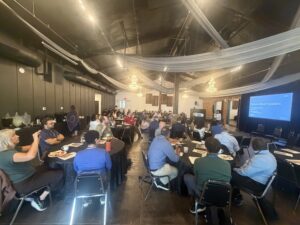
The Institute opened with a panel, “Tucson and Pima County’s Water Story,” which featured a range of perspectives from local municipal leaders, community organizations, and Tribal government representatives from the City of Tucson and the greater Pima County region. During the panel, speakers from Altar Valley Conservation Alliance, Flowers & Bullets, San Xavier District, Tucson Water, and the University of Arizona shared their organizations’ efforts to establish and implement nature-based solutions, reflected on how the regional landscape has evolved, and discussed lessons learned along the way. Participants learned how:
- Local community members encouraged Tucson Water to pursue equitable green stormwater infrastructure;
- Flowers & Bullets reinvigorated a former school campus within their urban community by installing nature-based solutions such as rainwater harvesting and community gardens, and eventually purchased the lot to create a space that services community needs;
- Tribal elders’ memories of the landscape helped inform riverbank restoration in the San Xavier District;
- The Altar Valley Conservation Alliance found that nature-based solutions are often the most straightforward and effective way to solve large and complex problems in their rural watershed.
These insights invited discussion and allowed participants to think about how these nature-based solutions could inform work in their own communities.
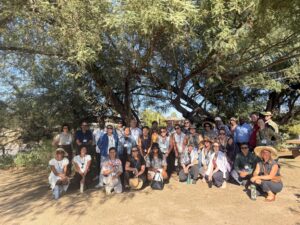
Through engaging site visits to El Vado Stormwater Park and the Dunbar/Spring neighborhood, participants saw real-world projects in practice and heard directly from the people leading them. In Dunbar/Spring, Brad Lancaster shared how neighborhood-scale efforts, including drainage improvements, native plantings, and permeable surfaces, helped demonstrate what is possible when residents take an active role in shaping their surroundings.
Together, the panel and site visits highlighted how nature-based solutions can take shape at different scales, from neighborhood-led efforts to projects involving multiple public agencies and community partners. They also showed how regional coordination can expand what is possible beyond the boundaries of any single project. 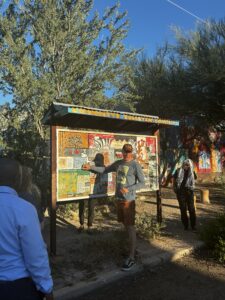
“Dynamic. Informative. Inspiring. And well thought out, I loved the mix of lecture and field trip. The time with Brad was so great and inspiring. So grateful this exists, thank you.” — Institute participant
Building Partnerships for Long-Term Stewardship
Nature-based solutions offer benefits beyond managing stormwater and reducing flood risk. They can also expand access to green space, help address extreme heat, and support local workforce opportunities. Realizing these benefits requires partnerships that bring together different types of expertise, resources, and relationships. The Institute’s “Regional Partnerships and Perspectives” panel highlighted how organizations across Tucson and Pima County are working together to advance the multiple benefits of nature-based solutions.
Through the panel, participants learned how:
- Storm to Shade explicitly identifies equity as the north star for investment decisions, prioritizing areas with the greatest need;
- Pima County Regional Flood Control District engineers and builds stormwater parks, and how they work with Tucson Water and Tucson Clean & Beautiful to support ongoing maintenance once the park’s construction is complete.
- Tucson Clean & Beautiful also works directly with residents, creating paid opportunities to help care for green infrastructure and involve community members in shaping projects in their neighborhoods.
- Partnerships with organizations such as Ironwood Tree Experience and programs such as NatureWorks help to connect young people with watershed health through hands-on learning and pathways into environmental careers.
These examples illustrate how partnerships can extend beyond project planning and construction to support long-term stewardship and community benefits.
After learning about these inspiring examples, participants reflected on the challenges of building and sustaining these types of relationships within their own communities. Challenges cited included institutional barriers, limited resources, and differing organizational priorities. Planning for these challenges, and for the people and resources needed to care for projects over time, is an important part of advancing lasting, community-centered nature-based solutions.
From Learning to Action: Launching the Nature-Based Solutions Taskforce
The conversations that began in Tucson will continue through the US Water Alliance’s Water Equity Network’s Nature-Based Solutions Taskforce. At the close of the Institute, eight utility and community partner teams kicked off their two-year effort to collaboratively implement nature-based solutions, identifying a new policy, an expanded program, a strategic partnership, or an on-the-ground project. The Taskforce will support participating teams as they explore and advance equitable, community-led nature-based solutions that strengthen climate resilience, build community wealth, and improve utility outcomes. Through peer learning exchanges and workshops, teams will explore ways to strengthen partnerships, support long-term stewardship, and move from shared goals to implementation. The eight teams represent: Pima County, Arizona; Houston, Texas; Raleigh, North Carolina; San Francisco, California; Honolulu, Hawaii; Pittsburgh, Pennsylvania; and Philadelphia, Pennsylvania.
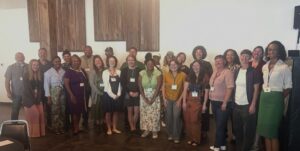
The US Water Alliance is grateful to Tucson Water and all the speakers, participants, and partners who made the Institute possible. The Alliance looks forward to continuing this work with the eight Taskforce teams over the next two years.